Context
Who is creating the jobs?
Is employment growth coming from the private economy or from taxpayer-funded sectors?
Who is creating the jobs?.
- Latest
- 52%
- Since the government took office
- Over the past year
Who is creating the jobs?
- Seasonally adjusted
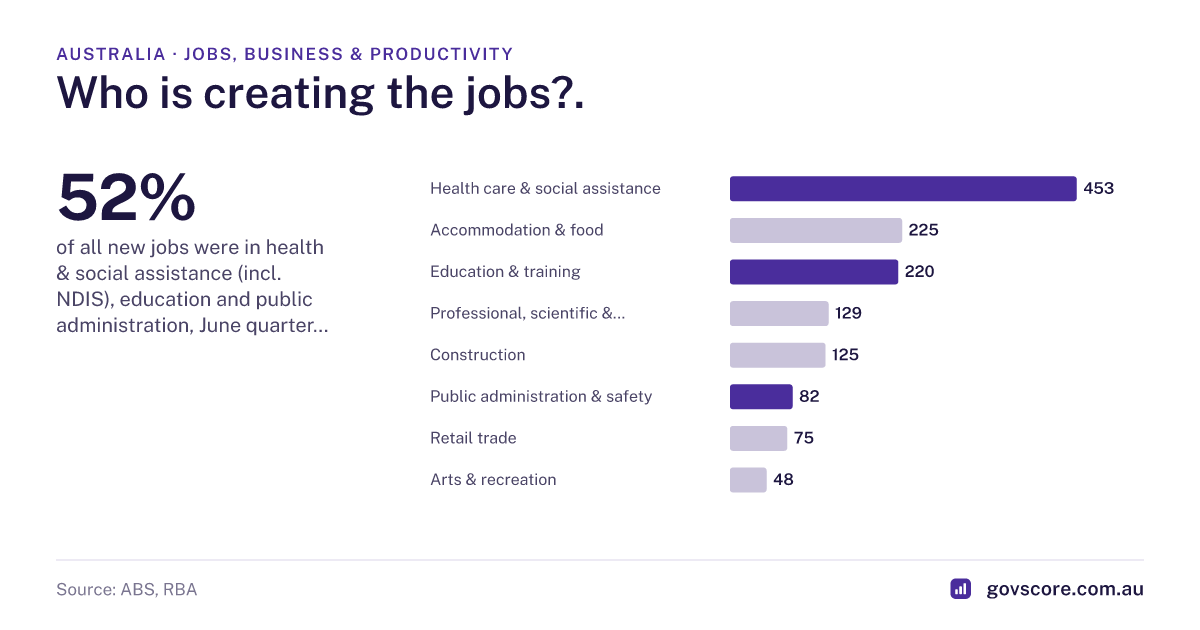
- Health care & social assistance453
- Accommodation & food225
- Education & training220
- Professional, scientific & technical129
- Construction125
- Public administration & safety82
- Retail trade75
- Arts & recreation48
- Transport, postal & warehousing47
- Financial & insurance31
- Mining30
- Electricity, gas, water & waste25
- Manufacturing9
- Information media & telecoms9
- Other services−1
- Rental, hiring & real estate−4
- Wholesale trade−8
- Agriculture, forestry & fishing−23
- Administrative & support−30
- Largely publicly funded industries
- Other industries
What this is
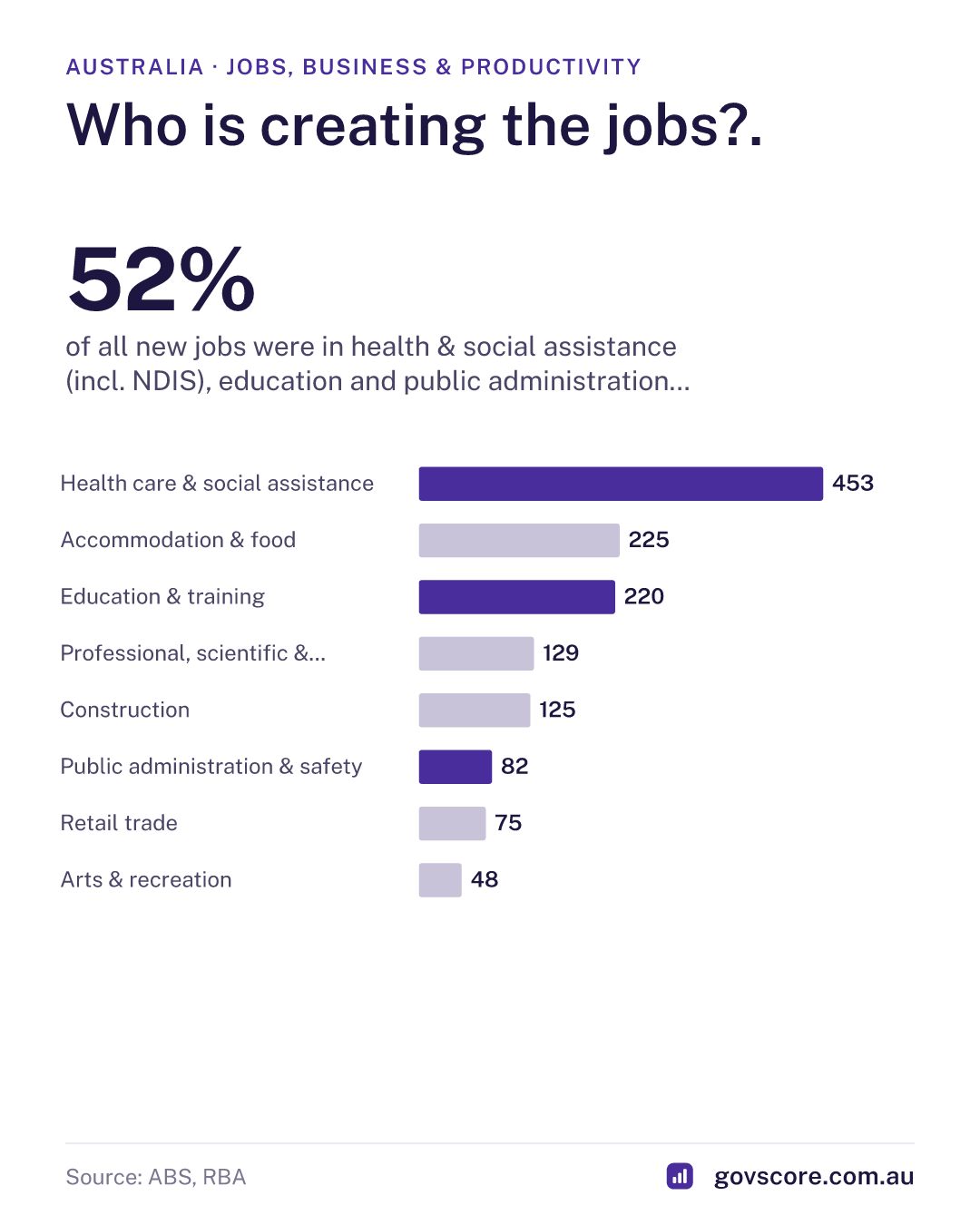
Change in filled jobs in each of the 19 major industries since mid-2022. Health care & social assistance (which includes NDIS and aged care), education, and public administration are highlighted. Economists call these the 'non-market' sector because they are mostly paid for by government.
Why it matters
Headline job numbers can look strong even when growth relies on government-funded programs rather than a thriving private economy. This shows where the jobs are actually coming from.
More from the figures
- Filled jobs grew by 1,445,000. 756,000 of them were in health care & social assistance, education and public administration. Health care & social assistance alone added 453,000.
- Those three industries held 27.3% of jobs in June quarter 2022. The other 16 industries, mostly the market economy, added 689,000.
- Economists call these three industries the 'non-market' sector because they are largely government funded. They include some private employers (such as private hospitals and schools), so this is not a pure public-sector count. See 'Public vs private sector jobs' for that.
- The Reserve Bank reported in November 2024 that around three-quarters of employment growth over the preceding year was in the non-market parts of the economy.
How it’s calculated
Change in ABS Labour Account filled jobs in each of the 19 ANZSIC industry divisions between the June quarter 2022 and the latest quarter. 'Non-market' = Health Care & Social Assistance + Education & Training + Public Administration & Safety. (The ABS ceased the Labour Force, Detailed industry tables in April 2026; the Labour Account is the continuing official quarterly source.)