Condition
Interest on government debt
How much are taxpayers paying just to service the debt?
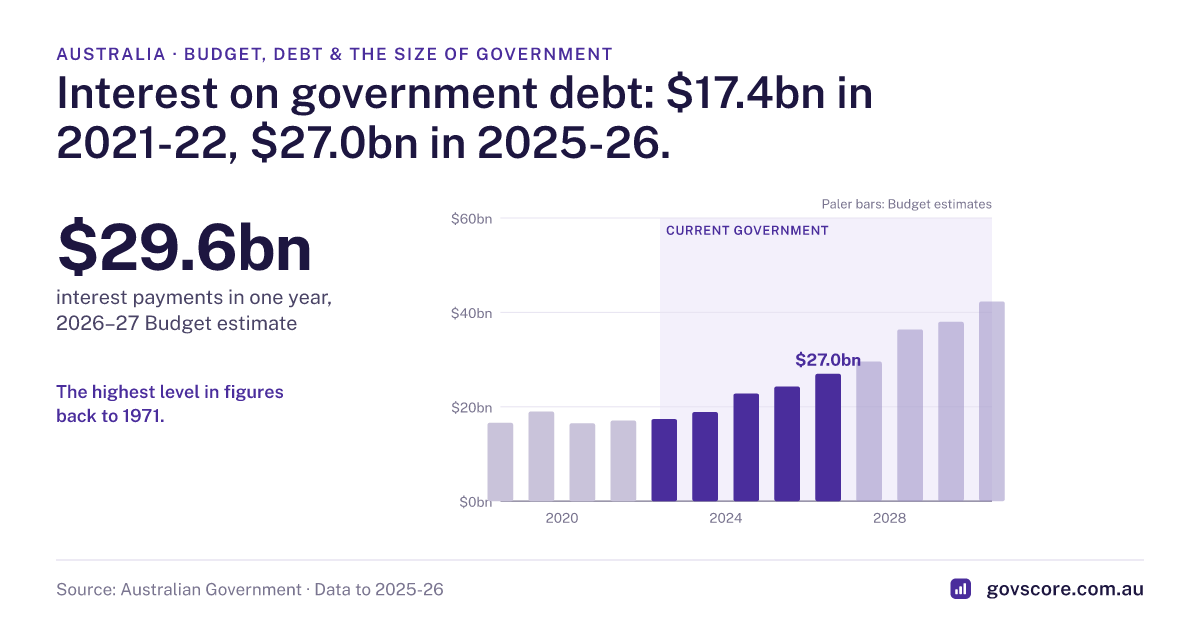
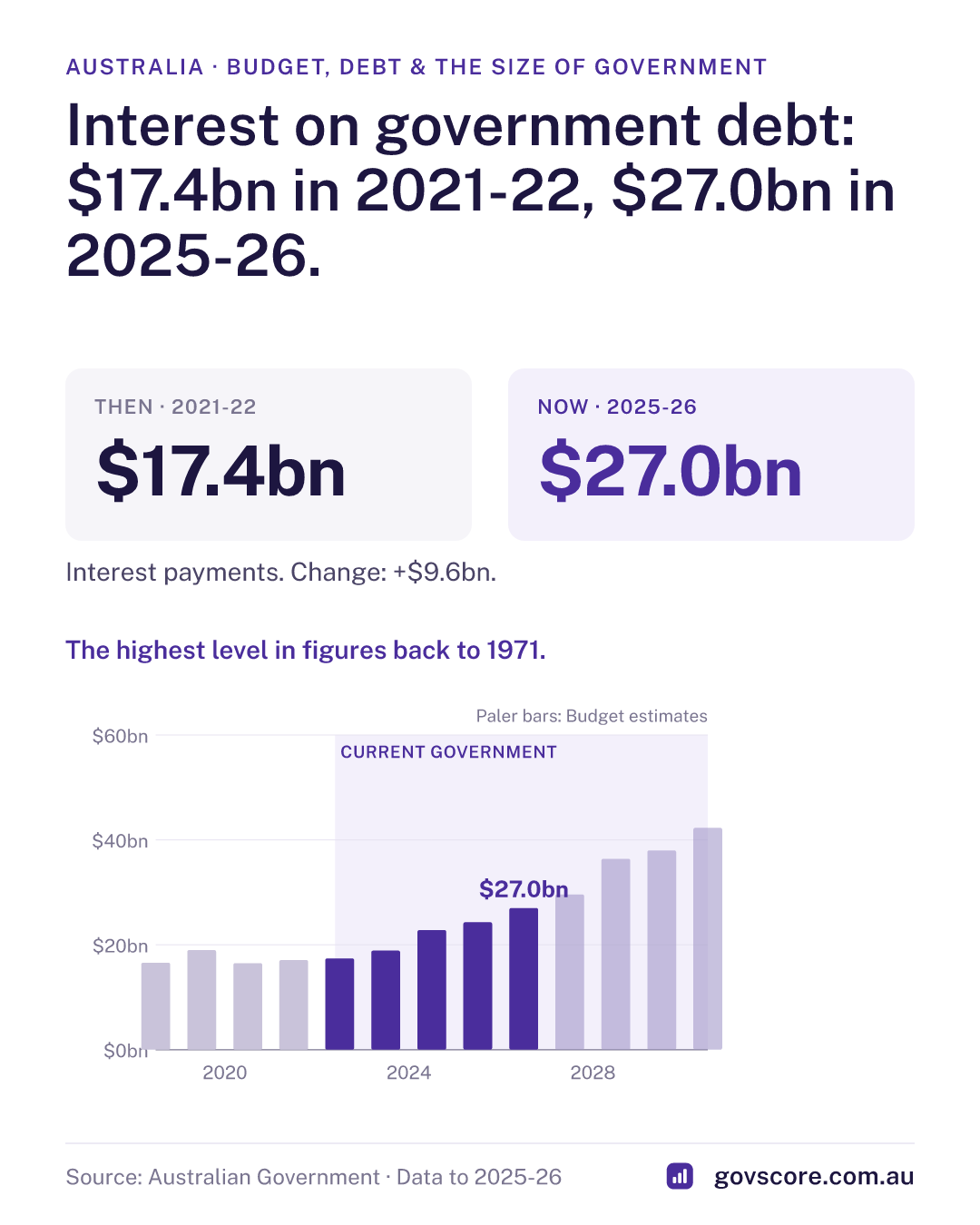
Interest on government debt: $17.4bn in 2021-22, $27.0bn in 2025-26. The highest level since the series began in 1971.
- Latest (Budget estimate)
- $29.6bn
- Since the government took office
- Worse+$9.6bn
- Over the past year
- Worse+$2.7bn
Interest payments ($ billion)
- Nominal $
- Cash payments
What this is
The interest the Commonwealth pays each year to the investors who hold its bonds. It rises when debt grows and when interest rates on new borrowing are higher.
Why it matters
Interest buys nothing: no hospitals, no defence, no tax relief. It is a direct cost of past and present deficits, and future taxpayers carry it.
More from the figures
- Interest payments rose from $17.4 billion in 2021-22 to $27.0 billion in 2025-26 (Final Budget Outcome), and are forecast at $29.6 billion in 2026-27 and $42.3 billion by 2029-30.
- The Budget itself says interest payments are expected to peak at 1.6% of GDP in 2032-33.
- In 2026-27 the government expects to spend more on public debt interest ($31.9 billion, accrual basis) than on transport and communication ($15.3 billion) and public order and safety ($9.7 billion) combined.
How it’s calculated
Interest paid (cash) from Budget Paper No. 1 2026-27, Statement 11, Table 11.5, with the 2025-26 actual from the Final Budget Outcome. The comparison with other spending uses accrual expenses by function (Tables 6.3 and 6.17), which is why public debt interest expense ($31.9b) differs from cash interest payments ($29.6b).